In Kristof's article, "Animal Cruelty or the Price of Dinner?" he eloquently makes an argument against the poultry industry. He begins with an anecdote about a man who was arrested in Florida for dangling his dog upside-down out of a twelve story window. This anecdote is really powerful, because he then calls attention to the nine billion chickens that will be slaughtered in the US this year by being dangling upside-down over conveyer belts. As I am a vegetarian, it is probably not surprising that I agree very strongly with his opinion. He then moves into discussing why poultry farming in its very nature is animal abuse and cites several experts, ranging from farmers to people on the corporate end of the operation. He also uses a quotation from Leah Garces, from the organization Compassion in World Farming. He quote Garces, "It is inhumane to breed a bird with a huge breast that its legs can barely support." This expert opinion in particular really changes his argument, in that it exemplifies his stance well. He does not say anything about vegetarianism or veganism in his writing- and although I do believe he would support both of these dietary styles as a means of improvement- what he is really proposing is for the means of the poultry industry to change. Kristof praises Whole Foods for proposing to sell chicken with more traditional genetics to avoid the issue that Garces illuminates. Although this change has not been implemented yet, I believe that once it is, people will begin to fulfill the author's vision to a much greater extent. Hopefully, if people continue to demand this, other food suppliers will have to follow the example Whole Foods will set. However, one could argue that this is not something that could be feasibly implemented due to the fact that a change in genetics could take a lot of time, cost money to companies and consumers, and also potentially preventing their being enough supply to meet demand. If I was rewriting this argument, I would try to address these concerns and also add more of an emotional appeal.
I accessed this article through the NY Times website: http://www.nytimes.com/2016/04/17/opinion/sunday/animal-cruelty-or-the-price-of-dinner.html?ref=opinion
Sunday, April 17, 2016

Sunday, April 10, 2016
TOW #23 Banksy's Work on the West Bank Barrier
In a series of work that Banksy did on the West Bank Wall, he communicated his strong opposition towards the massive barrier. In some statements he released regarding his opinion towards the West Bank Wall, he declared that "It essentially turns Palestine into the world’s largest open-air prison". In this regard, I have to agree with Banksy, considering not only the wall itself but also the tragic way of life that the people constrained by it are forced to experience. The particular mural I decided to interpret struck me as a really powerful image, as it depicts two young children with sand pails and shovels, completely cut off from the ocean that is shown coming through cracks on the wall. I think this is really representative of the restrictive nature of the wall, and also who the wall is really hurting- not the violent extremists that it was meant to protect from, but rather innocent people and children. If I could create my own version, I would make it a series to really show the wide variety of people who are seemingly punished by the wall. The biggest 'source' that Banksy's work needs to accomplish its intended purpose is really just its very backdrop, the wall itself. The massive barrier, three times the height of the Berlin wall, proves his point for him. While as a Jewish-American it is my natural tendency to favor Israel, I do not think it is ethical to use such aggressive means. I think that Banksy would be even more outraged with what is going on today, considering that he created this work around 2003 and little has changed since. Additionally, in the past year the prime minister of Israel proclaimed that he would not be willing to try to reach compromise with Palestinians through the implementation of two state solution. This makes the situation seem even more bleak for the oppressed people that Banksy was trying to advocate for over a decade ago. Even though I agree with what the artist is trying to communicate, I can also recognize the validity in the opposing argument. Israel and Palestine have a troubled history, with a great deal of violence afflicted on each side by the other. Therefore, for the protection of both Israelis and Palestinians, having some kind of barrier certainly makes sense due to the harmful extremists on both sides.


Saturday, April 2, 2016
TOW #22 "Why Slaves' Graves Matter" by Sandra Arnold
The Arnold's central claim is that, "Our country should explore ways to preserve the public memory of enslaved Americans," in order to contribute to healing, help understanding and potentially lead to reconciliation. I completely agree with the statements that Arnold's makes, especially after reading the piece and seeing all of the sound and convincing evidence that she includes in the piece. The sources that she includes, such as statistics from various burial grounds and communities make her piece much stronger and really back up what she is trying to communicate. In addition, the argument is as well supported as it is well written. The author uses inductive structure to make a really strong point, beginning with smaller conclusions about all of the positives that slaves' graves could contribute to, and ends by tying all of these smaller conclusions into one larger concept that comprises her central claim. Arnold also utilizes the classical model of oration for the most part, but embellishes with narrative and actually does not really have much of a counter argument section. However, if someone was trying to refute Arnold's claim, they could definitely suggest that stronger action be taken in order to ensure remembrance, far beyond allocated land with the purpose of burial ground preservation. One could argue that having historical societies put in place, as well as upping the amount of education on this subject in schools would be more effective. Even so, Arnold may not disagree with these notions. Although she focuses on the importance of slaves' having proper commemorative graves, from other statements that she makes it is evident that she would certainly not protest anything that would lead to communities being more educated on slavery and the fundamental impact that slavery had on our modern society. Even though the country's level of education on this subject is far from ideal, more and more steps are being taken to make the author's vision a reality. We fulfill this vision more and more, as we begin to see ex slaves less and less as unfamiliar, and more and more as our ancestors.
I found this piece digitally on the NY Times site: http://www.nytimes.com/2016/04/03/opinion/sunday/why-slaves-graves-matter.html?ref=opinion
I found this piece digitally on the NY Times site: http://www.nytimes.com/2016/04/03/opinion/sunday/why-slaves-graves-matter.html?ref=opinion
Sunday, March 13, 2016
TOW #21 "The Bernie Sanders Revolution" by The NY Times Editorial Board
In this article, the NY Times Editorial Staff accesses the validity in Bernie Sander's most frequently used word in his campaigning, "revolution." The Times Editorial staff argues that Sanders will not be able to actually induce a revolution, but rather an evolution at best. As a very big Sanders supporter, I can definitely think of some examples that would argue against this particular take on the situation. Sanders has a great deal of experience and has made some enormous strides towards progress during the fifty plus years that he has played an active role in politics. He also has a large, passionate group of supporters willing to do whatever it takes to implement his bold ideas. However, I think I have to agree with the Editorial Staff overall in that I do think Sanders will be able to create a great deal of change, just not necessarily in an immediate sense. A revolution is usually defined as a dramatic 180 degree turn which results in a change in direction of sorts. I think that while a change is inevitable, and a new direction for American would surely occur if he became President, it would take a lot of time and effort for his ideas to be implemented. Even though it would be really helpful to have such a liberal person overseeing the executive branch of government, there would still be some major disputes with the other various branches of government. A really strong example that the author provides regarding how we fulfill the author’s vision today is some of the setbacks that Barak Obama faced during his presidency. Although he certainly had many great ideas and programs, many of these plans were put on pause by the Senate, preventing him from being able to implement, them. He uses many figures that outline the percent of the House and Senate that are republican, in addition to drawing statements from websites who campaign for and against Sanders. This contributes to the argument in that it seems much more logical, and gives a more well-rounded take on the situation. If I were to rewrite this argument, I would want to add even more of these sources earlier on. Considering how strongly this argument makes its claim, it is most likely safe to say that the author does not believe any president could make a revolution happen overnight. I think we can assume that Trump is no more likely to "make America great again," than Sander is to spark a revolution.
Saturday, March 5, 2016
TOW #20 "What If Animals Tested on Humans?" by PETA
This visual text, published by PETA (People for the Ethical Treatment of Animals) really caught my attention because of the strong claim it's making and the strong visual means it uses to make this claim. Overall, I do agree with the author's claim in that I believe animal testing for cosmetic purposes is unethical. However, the portion of the add that states that the add is only against cosmetic testing isn't emphasized at all so it seems as though it is against all animal testing. Although I am definitely a huge animal lover, I do think that for scientific and medical reasons some animal testing should be allowed. So many incredible scientific discoveries have come from animal testing, and any of these advancements and innovations could be used to challenge the author's position. Additionally, because the advertisement doesn't qualify exactly what "cosmetic" pertains to, someone could easily talk about skin treatment and things along those lines that seem much more essential, rather than talking about the luxury lipstick and mascara that people may usually think of.
PETA usually caters to a very extreme group of people, so my guess as to why the fact that this advertisement deemphasizes the fact that it is just about cosmetic testing was probably very strategic. PETA supporters often argue against eating animals and animal byproducts, animal testing, animal exploitation, and very strong against animals being used for fur. However, with advertisements such as this one, PETA is not merely trying to gain the support of people who already avidly support their cause. I think that this advertisement does a really good job in being relatable, but also playing off of something surreal in order to make sure it catches the eye. Most people grow up with this concept of terrifying aliens abducting humans and doing horrible things to them due to the way aliens are portrayed in most movies and television shows. So, this concept is somewhat familiar. Yet, this advertisement is definitely one that is hard to miss due to the juxtaposition of color and form, plus the giant green alien in the back. I think the sense of flashiness that is created by this strong composition is definitely something I would choose to incorporate if I was making my own visual text similar to this. Also the add, which was originally featured in a Bollywood magazine, featured a famous actress which would also greatly help its success.

PETA usually caters to a very extreme group of people, so my guess as to why the fact that this advertisement deemphasizes the fact that it is just about cosmetic testing was probably very strategic. PETA supporters often argue against eating animals and animal byproducts, animal testing, animal exploitation, and very strong against animals being used for fur. However, with advertisements such as this one, PETA is not merely trying to gain the support of people who already avidly support their cause. I think that this advertisement does a really good job in being relatable, but also playing off of something surreal in order to make sure it catches the eye. Most people grow up with this concept of terrifying aliens abducting humans and doing horrible things to them due to the way aliens are portrayed in most movies and television shows. So, this concept is somewhat familiar. Yet, this advertisement is definitely one that is hard to miss due to the juxtaposition of color and form, plus the giant green alien in the back. I think the sense of flashiness that is created by this strong composition is definitely something I would choose to incorporate if I was making my own visual text similar to this. Also the add, which was originally featured in a Bollywood magazine, featured a famous actress which would also greatly help its success.

Saturday, February 27, 2016
TOW #19 "Review: ‘Full House’ Sequel Is a Forced March Down Memory Lane" by James Poniewozik
In his review of the recently premiered "Fuller House"( A"Full House" sequel) James Poniewozik shares a very strong opinion arguing that the Netflix series could at best be called "not good" due to the its lack of originality, betrayal of the original show, and cringe worthy content. He humorously compares, "To make a “Full House” sequel “good” — less formulaic, more innovative — would be like baking an artisanal, organic Hostess CupCake: You could do it, it might be delicious, but it would be a betrayal of the product." (para. 1). Although I found the pilot of the show to be quite amusing, I have to agree with Poniewozik. There isn't much cause However, one could certainly argue that there is something good about the series considering that it has gained lots of attention and made the Netflix "popular page" within only a few hours. Additionally, it could also be said that the series was not made with the intention of reinventing "Full House," but actually allowing viewers of the show to reminiscence. Since the audience of the original show is probably 'all grown up' at this point, there is definitely something positive about the fact that the new show is something they can watch with their families and share a part of their childhood. Yet, there is something rather conflicting about this concept because it would seemingly be much easier, and much more accurate, for "Full House" lovers to just share the original series with their families instead of the newer one. Considering that much of the content on "Fuller House" alludes to the original, there is definitely some fallacy to be accounted for with this argument.
Poniewozik's apparent frustration is completely valid in the midst of a generation of television that seems to plagued with spinoff after spinoff after spinoff. Seldom is it that a televsion show, or even movie, of this nature can even be compared in success and quality to the original. This would be an interesting topic to get into, especially if it involved accounting in why it is so difficult for a decent sequel to be produced from such a popular original. Assuming that the author would feel similarly about other seemingly unnecessary sequels, I doubt he would be a fan of the next Harry Potter movie, not to mention the other many sequels coming out this year.
Poniewozik's apparent frustration is completely valid in the midst of a generation of television that seems to plagued with spinoff after spinoff after spinoff. Seldom is it that a televsion show, or even movie, of this nature can even be compared in success and quality to the original. This would be an interesting topic to get into, especially if it involved accounting in why it is so difficult for a decent sequel to be produced from such a popular original. Assuming that the author would feel similarly about other seemingly unnecessary sequels, I doubt he would be a fan of the next Harry Potter movie, not to mention the other many sequels coming out this year.
Sunday, February 21, 2016
TOW #18 "Why Do We Teach Girls That It’s Cute to Be Scared?" by Caroline Paul
This week I was absolutely wowed by "Why Do We Teach Girls That It’s Cute to Be Scared?" by writer and firefighter, Caroline Paul. Although Paul does not have an extensive collection of published work, her experiences as one of the first female firefighters for the San Francisco Fire Department and her New York Times publication led me to regard her as a highly credible author. In her piece, she shares her personal experience in a convincing narrative format that left me pondering the gender stereotypes that are ingrained into us by society from the time we are too young to even realize it. I walked away from this article with a completely new appreciation for all of the times that my Mom and Dad told me to "quit being damsel in distress" when I got stuck in a tree or on top of the monkey bars. However, the reliability of the piece is not exclusive to girls who were raised by parents who encouraged them to face problems on their own but also the "10 year old girls who were taught it was cute to screech 'I'm too scared'" (para. 14). Through her use of anecdotes, first-person plural pronouns, and statistics from the Journal of Psychology, Paul creates a logical, yet emotionally appealing, argument disagreeing with the accepted norms that teachers girl to be delicate instead of taking risks.
Paul begins by sharing several of her more daring feats as a female firefighter: "I’ve pulled a bloated body from the bay, performed CPR on a baby and crawled down countless smoky hallways," (para. 1) and ends her piece with what she believes allowed her to accomplish these incredible things: " I put my fear where it belonged, behind my feelings of focus, confidence and courage," (para. 15). These examples make her argument much stronger and also evoke feelings of admiration, as these feats are very impressive to begin with considering that she literally saved lives. Since her purpose is to not only draw attention to this negative stereotyping but also to get her audience to do something about it, this is really effective. She also repeats the word "we" over and over again which helps her piece feel very relatable and also make it seem like something the audience should really take an interest in. Additionally, the statements Paul utilizes from the Journal of Psychology help bring a strong logical appeal into a very emotionally based argument. The combination of devices helps her really achieve her purpose, as does the occasion in which the text was written. In an era of great social change, it is crucial that strong female role models step away from social norms and show the potential in all.
I accessed this article through the NY Times website: http://www.nytimes.com/2016/02/21/opinion/sunday/why-do-we-teach-girls-that-its-cute-to-be-scared.html?ref=opinion
Paul begins by sharing several of her more daring feats as a female firefighter: "I’ve pulled a bloated body from the bay, performed CPR on a baby and crawled down countless smoky hallways," (para. 1) and ends her piece with what she believes allowed her to accomplish these incredible things: " I put my fear where it belonged, behind my feelings of focus, confidence and courage," (para. 15). These examples make her argument much stronger and also evoke feelings of admiration, as these feats are very impressive to begin with considering that she literally saved lives. Since her purpose is to not only draw attention to this negative stereotyping but also to get her audience to do something about it, this is really effective. She also repeats the word "we" over and over again which helps her piece feel very relatable and also make it seem like something the audience should really take an interest in. Additionally, the statements Paul utilizes from the Journal of Psychology help bring a strong logical appeal into a very emotionally based argument. The combination of devices helps her really achieve her purpose, as does the occasion in which the text was written. In an era of great social change, it is crucial that strong female role models step away from social norms and show the potential in all.
I accessed this article through the NY Times website: http://www.nytimes.com/2016/02/21/opinion/sunday/why-do-we-teach-girls-that-its-cute-to-be-scared.html?ref=opinion
Friday, February 5, 2016
TOW #17 "Everyone I Have Ever Slept With" by Tracey Emin
I was first introduced to Tracey Emin's work in art class when I had the opportunity to do some research on her, and ever since I have been a huge fan. Emin has been a prominent figure in the art world for decades and it really isn't very hard to see why. Aside from her technical skill and unique design aesthetic, I think the most remarkable quality about her work is the unique thematic messages she puts forward. She often plays with the ideas of the way that one views oneself, and nuances her work with her take on the role of gender in society as well as the way that this effects sexuality. I think her work "Everyone I Have Ever Slept With" exemplifies all of these themes in a painstakingly beautiful way. The installation itself is rather interesting by the very fact that every viewer is encouraged to actually climb inside the tent like structure that Emin created and adorned with the names of everyone she has ever been intimate with. This ultimately makes for a very interesting situation in which viewers begin my questioning the artist, and then begin to question themselves and what it truly means to be intimate with someone. Without the structural components, the rhetorical situation would not be nearly as interesting, nor it would be nearly as meaningful as it is. By making her audience literally climb inside the inner-workings of her mind, she is able to open up a dialogue between the audience and herself and make them mentally and physically go deeper into the piece. Additionally, her use of texts almost helps her create a series of anecdotes. When I looked at the various names sewn inside the tent I could not help but think of all the weight that these names probably carried at one point or another in the span of Emin's life. Through the different application of the text utilized for the names on the inside of the tent, and the additional phrases on the outside, Emin creates a really interesting appeal to her audience. By sharing snippets of her own stories, she makes one think back on their own.


Saturday, January 30, 2016
IRB #3 Introduction
This marking period I will be reading, Deep: Free-diving, Renegade Science, and What the Ocean Tells Us about Ourselves, by James Nestor. This book was recommended to me by a good friend of mine, who said it was an absolute must read. So far it seems really interesting in content, as well as a really well-written piece of literature. I also think it'll be a very unique book compared to others I have read because it blends the factual with the philosophical. Can't wait to get started!
Sunday, January 24, 2016
TOW #16 IRB "The Right Stuff" by Tom Wolfe
For this cycle of TOWs I was able to finish the second half of, The Right Stuff, by Tom Wolfe. I definitely enjoyed the second portion of the book much more than the first. This is mostly because as I started to get to know the individual characters, it stopped feeling like a boring book about space and became something that I could really relate to. I think Wolfe accomplished something really special with The Right Stuff, because he took a series of historical events that could easily be boiled down to a list of bullet points recounting the facts, and turned it into something so much more than that. In this sense, he really achieved his purpose of both educating and entertaining his readers- his experience as a journalist definitely helped his credibility in the factual evidence, but also his knowledge on how to really appeal to people. It is the little things, like clever anecdotes in which Glenn supports his wife when she is too timid to let the vice president into their house, that really make the book an experience. Even though events like this have nothing to do with the space race, they are really powerful in revealing the nature of the seven men who were chosen for the program. From family-men Glenn and Carpenter, to bold Shepherd, the program was filled with strong personalities all tied together with "the right stuff". The second half of the book focuses around the right stuff needed for the group of seven to be successful, for example staying cool under pressure which was necessary both in space and throughout the astronauts rise to fame. It also continues to use strong imagery and anecdotes to detail the various flights, and the events that surrounded them. In addition to these two devices, Wolfe also relies heavily on the repetition of a meaningful phrase to achieve a thematic purpose. He constantly refers back to phrases like, "our boys always botch it," and
"pushing the outside of the envelope," to make a strong point that will stick with his audience. I really loved reading this book, and I think I will definitely want to read more of Wolfe's work in the future.
Sunday, January 17, 2016
TOW #15 "The 3 Most Important Things in Life" (Section Two)
In the second section of his essay, The 3 Most Important Things In Life, Harlan Ellison transitions into a much more serious tone, while still playing off of his token sense of humor that was established in the first. His answer to the seldom pondered question of what the most important things in life are is very different than most other people's beliefs. He devotes the entire second section to violence, sandwiching it in between sex and labor relations. Although Ellison is an acclaimed writer both in the form of novellas, short stories, and screenplay- this is not enough to establish his credibility as someone who can reveal the true most important things in life. In order to gain the ethos needed in order to actually get his audience to buy into what he is saying, Ellison relies on anecdotes, and a very conversational way of writing.
In this section, Ellison shares an anecdote in which he and a good friend of his went to go see a movie in New York. In the middle of the movie three people began to argue in the section in front of Ellison and his friend. As the situation escalated things got violent, causing one of the people arguing to get pushed off of a balcony. Rather than trying to aid the severely injured, if not already dead, person, the people in the theater just continued to watch the movie. In the conclusion of the section, Ellison writes, "Genuine, mindless violence is very important. Because there is no knowing when it will strike. And there is no escaping from it." This anecdote is essential to achieving his purpose as it exemplifies the point he is trying to make about violence perfectly. He demonstrates, through his personal experience, the importance and inescapable nature of violence. In addition, he is able to establish his credibility even further because it is a story of something he actually lived through and therefore he has the utmost authority on it. He continues to play on this with the conversational, often humorous tone that he uses. He mimics the men in the theater, using a range of swear words and very casual slang. By doing this, he creates an open dialogue between himself and his readers.
Saturday, January 9, 2016
TOW #14 "Dropping a Han Dynasty Urn" by Ai WeiWei
Ai Weiwei is easily the most famous artists from China, and arguably one of the most influential figures in the world of twenty-first century art altogether. His reputation for controversial work has not only landed him a regular spot in the limelight, but also several serious arrests throughout his career. Featured in his most recent exhibit titled, "According to What?" is a series of three photographs taken of the artist in 1995. Titled, Dropping a Han Dynasty Urn, Weiwei is shown dropping an ancient Chinese vase to the ground. Considering that the pictures have sparked lots of debate on almost every major media outlet, his audience has gone far beyond those who attend the small gallery where his work is held,
This breathtaking triptych has a rich thematic meaning, as shown by the vast variety in interpretations throughout the last two decades. I believe that what Ai Weiwei is getting at with this piece is the tendency of history to takeaway from the precise social order that nations such as his native country of China strive for. This often causes governments to lash out, and either attempt to destroy or change history. The thing I found the most fascinating is that he chose to do the physical destroying himself, and in later work chose to alter similar artifacts. He often ridicules the injustices of Chinese society in his work, and I am relatively certain that this piece is no exception considering the fact that he literally smashes a treasure from ancient China to the ground. Through his juxtaposition of the ancient and the modern, and his strong allusion to the Chinese cultural revolution, Weiwei takes a strong stance and calls into question the validity of the version of history that is taught and the ways in which it is manipulated. Overall the photographs are rather simplistic, which help draw attention the dropping of the vase. However, it is difficult not to notice the disparity in Weiwei's contemporary garb in contrast to the tractional looking vase. This sense of juxtaposition is also played off of by the strong contrast of black and white. This, and his obvious reference to the events that took place during China's cultural revolution help him make a very strong statement, that I think is masterfully done. I am doubtful that I will ever forget this impactful piece of artwork, and I am sure many others would say the same.

This breathtaking triptych has a rich thematic meaning, as shown by the vast variety in interpretations throughout the last two decades. I believe that what Ai Weiwei is getting at with this piece is the tendency of history to takeaway from the precise social order that nations such as his native country of China strive for. This often causes governments to lash out, and either attempt to destroy or change history. The thing I found the most fascinating is that he chose to do the physical destroying himself, and in later work chose to alter similar artifacts. He often ridicules the injustices of Chinese society in his work, and I am relatively certain that this piece is no exception considering the fact that he literally smashes a treasure from ancient China to the ground. Through his juxtaposition of the ancient and the modern, and his strong allusion to the Chinese cultural revolution, Weiwei takes a strong stance and calls into question the validity of the version of history that is taught and the ways in which it is manipulated. Overall the photographs are rather simplistic, which help draw attention the dropping of the vase. However, it is difficult not to notice the disparity in Weiwei's contemporary garb in contrast to the tractional looking vase. This sense of juxtaposition is also played off of by the strong contrast of black and white. This, and his obvious reference to the events that took place during China's cultural revolution help him make a very strong statement, that I think is masterfully done. I am doubtful that I will ever forget this impactful piece of artwork, and I am sure many others would say the same.
Friday, December 18, 2015
TOW #13 "The Death of the Artist—and the Birth of the Creative Entrepreneur" by William Deresiewicz
William Deresiewicz is an acclaimed editorial writer who has been writing for The Atlantic since 2014, and recently released his own novel. He focuses his writing around common trends in American culture, usually focusing his work around the arts and literature. Hence, the subject matter of his piece, "The Death of the Artist—and the Birth of the Creative Entrepreneur" does not come as much of a surprise. Deresiewicz begins this piece with a lesson in art history, as well as information on the ever-changing nature of what defines art. For the most part, this section is very factual. Additionally, he uses statements from many historians to add to the overall credibility. This demonstrates that what he is saying is correct and factual, which sets him up to have a credible opinion later in the piece. He also highlights the various definitions of the word artist, and the way that expectation of what an artist should be has changed drastically along with society. In doing so, he creates a juxtaposition with what artistry was, as opposed to what it is now. By adding such emphasis to the vast differences, Deresiewicz is able to demonstrate to his readers that the current definition of art was not always the norm. In many ways, Deresiewicz's writing is a reaction to the art movement that is happening now. The main two aspects of the modern-art world that he highlights are the nature of artists to take on various mediums, as well as the simple fact that in the twenty-first century popularity benchmarks the success of a piece. Although neither of these things are necessarily bad in their own right, Deresiewicz is able to give them both a very negative connotation through nuances created by his choices of vocabulary. He uses words such as, "sink, mourn, disappear, lose, etc." to point his readers in what he believes is the right direction, without forcing his opinion at them. This also helps set up the many rhetorical questions that he employs, in which he gives his audience lots of room to think for themselves- after he has given them a great deal of evidence supporting his opinion. Readers of The Atlantic are generally very well-educated, so it is safe for him to assume that they will logically evaluate the issue he presents on their own. Through his references of credible sources, juxtaposition, carefully chosen diction, and rhetorical questions, Deresiewicz creates a very strong argument that makes his audience reconsider the definition of art that has become a societal norm. I really enjoyed this piece, as it was very informative and really made me question myself in a sense of my own artwork and preconceived notions I had about what it means to truly be an artist.
I accessed this article on The Atlantic's website after first seeing it on Mr. Miller's website, and I would definitely recommend checking it out: http://www.theatlantic.com/magazine/archive/2015/01/the-death-of-the-artist-and-the-birth-of-the-creative-entrepreneur/383497/
I accessed this article on The Atlantic's website after first seeing it on Mr. Miller's website, and I would definitely recommend checking it out: http://www.theatlantic.com/magazine/archive/2015/01/the-death-of-the-artist-and-the-birth-of-the-creative-entrepreneur/383497/
Sunday, December 13, 2015
TOW #12 IRB "The Right Stuff" by Tom Wolfe
Tom Wolfe's, The Right Stuff, is an entertaining and informative read that I would highly recommend to anyone looking for a good non-fiction book that flows more like a traditional work of fiction. Wolfe seamlessly blends the abstract details from his own mind with the actual events and realities of the situations that he depicts throughout his work. I was pleasantly surprised at how much I am liking the book so far, and this factor of something being so concrete, yet also feeling "larger than life," definitely added to my personal level of enjoyment. Throughout approximately the first half of the, The Right Stuff, Wolfe focuses on the U.S.'s fascination with space exploration in the post-war era. However, I found the book to be more about the space race than the actual travel into space. In addition, the most important factor of the novel is the characters: whose bravery, and at times absurdity, eventually made the voyage into space possible for the nation. This daring and readiness to take enormous risks seemed to be exactly what Wolfe would describe as the right stuff to get the job done. When he published the book in 1979, Wolfe was already an acclaimed journalist who wrote for a wide variety of newspapers and magazines. His extensive body of non-fiction work makes him much more credible to modern-day readers, but also helped him compose the book when he was writing. The first Americans landed on the moon less than ten years before the release of, The Right Stuff, and so Wolfe was able to utilize those who were still alive as primary sources for the book.
Throughout the first half of his book, Wolfe uses a combination of strong imagery and juxtaposition to highlight the courage of the Mercury Seven, who were NASA's first astronauts. The juxtaposition is really helpful for readers, as it makes a much more stark difference between the astronauts and the test-pilots who almost got the job instead. He shows the difference in personality, training, and ethics in order to reveal the complexity of the issues that faced the men. Additionally, he uses strong imagery in order to grab the audience's attention and add detail. From the very beginning of the book, the powerful descriptions that he writes really set the tone for the rest of the novel, "And today, here in Florida, in Jacksonville, in the peaceful year 1955, the sun shines through the pines outside, and the very air takes on the sparkle of the ocean. The ocean and a great mica-white beach are less than a mile away," (Wolfe, pg. 2). He also uses imagery to turn the audience's attention to what really matters: the people, rather than the events.
Throughout the first half of his book, Wolfe uses a combination of strong imagery and juxtaposition to highlight the courage of the Mercury Seven, who were NASA's first astronauts. The juxtaposition is really helpful for readers, as it makes a much more stark difference between the astronauts and the test-pilots who almost got the job instead. He shows the difference in personality, training, and ethics in order to reveal the complexity of the issues that faced the men. Additionally, he uses strong imagery in order to grab the audience's attention and add detail. From the very beginning of the book, the powerful descriptions that he writes really set the tone for the rest of the novel, "And today, here in Florida, in Jacksonville, in the peaceful year 1955, the sun shines through the pines outside, and the very air takes on the sparkle of the ocean. The ocean and a great mica-white beach are less than a mile away," (Wolfe, pg. 2). He also uses imagery to turn the audience's attention to what really matters: the people, rather than the events.
Saturday, December 5, 2015
TOW #11 "First Comes Baby, Then Comes Push Present?" by Una LaMarche
In, "First Comes Baby, Then Comes Push Present?" NY Times staff-writer Una LaMarche questions the nature of the flamboyant "push presents" that celebrities such as Kim Kardashian have popularized more and more in the past few years. LaMarche is known for her cleverly sharing her thoughts on subjects such as feminism, privilege, and critiquing the modern-day media in the form of her own books, writing for the NY Times, and also guest-writing for the Huffington Post. With this in mind, I really did not need to question her credibility and knowledge on this subject matter, and also took her previously shared views into account when looking for nuances to alter my interpretation of the piece. In this particular writing, it seems as though she is talking to all women who have, or plan to have, children. In addition to sharing her own passionate opinion, she uses statements from women and medical professionals alike to make a very firm argument that ridicules the sincerity of "push-presents" and what they imply about a woman. Her purpose in writing is not in any means to say that women do not deserve to be shown some kind of gratification after enduring carrying a baby for nine months and then delivering some- she more so takes issue with the given name. She wittily proclaims, "it is hard to deny that the unfortunate name makes women sound like human slot machines waiting to spit out a jackpot," (para. 5). She skillfully achieves her purpose by writing something that is strongly worded enough to show significance, but also neutral enough to not make her readers feel the need to "get defensive."
To achieve her purpose on a somewhat controversial topic by using a multitude of rhetorical devices and strategies, including juxtaposition, allusion, and helps her argument seem more logical by addressing the counterargument. She juxtaposes celebrities like Kim Kardashian with common people, and their thinking around "push presents." She does show to show the disparity between what is normal, and what is normal for a celebrity who can spend a million dollars on a necklace without thinking about it twice. In her contrast of the average women a celebrity, she alludes to the major differences in those who are extremely wealthy, as well as the way that this impacts someone's view on feminism. This greatly helps her achieve her purpose by showing the relevance of the issue she describes, and makes sure her audience knows that she is not just choosing to argue over something as small as a name. In addition, she addresses the counterargument, to show that she is aware of, and respects the other sides opinion. In doing so, she creates a very powerful argument that definitely changed the way I thought about the subject.
I accessed this article on the NY Times website: http://www.nytimes.com/2015/12/03/fashion/kim-kardashian-push-present-politics.html?ref=fashion&_r=0
This cartoon was included with the article, and I thought it did an awesome job in setting up LaMarche's ideas:
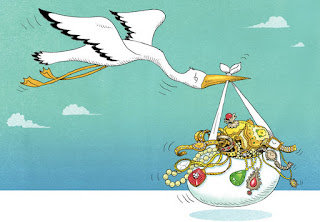
To achieve her purpose on a somewhat controversial topic by using a multitude of rhetorical devices and strategies, including juxtaposition, allusion, and helps her argument seem more logical by addressing the counterargument. She juxtaposes celebrities like Kim Kardashian with common people, and their thinking around "push presents." She does show to show the disparity between what is normal, and what is normal for a celebrity who can spend a million dollars on a necklace without thinking about it twice. In her contrast of the average women a celebrity, she alludes to the major differences in those who are extremely wealthy, as well as the way that this impacts someone's view on feminism. This greatly helps her achieve her purpose by showing the relevance of the issue she describes, and makes sure her audience knows that she is not just choosing to argue over something as small as a name. In addition, she addresses the counterargument, to show that she is aware of, and respects the other sides opinion. In doing so, she creates a very powerful argument that definitely changed the way I thought about the subject.
I accessed this article on the NY Times website: http://www.nytimes.com/2015/12/03/fashion/kim-kardashian-push-present-politics.html?ref=fashion&_r=0
This cartoon was included with the article, and I thought it did an awesome job in setting up LaMarche's ideas:

Sunday, November 22, 2015
TOW #10 "Choose to Be Grateful. It Will Make You Happier" by Arthur Brooks
In Arthur Brooks's popular piece for The New York Times, he begins to delve into his thematic purpose with a question asked to him by his Spanish in-laws on the topic of Thanksgiving: "Should you celebrate this holiday even if you do not feel grateful?" (para. 3). As this holiday is right around the corner, he brings up a very glazed over question that the American population seldom asks themselves. Through the combination of Brooks's use of statistics and his personal anecdotes he makes a strong argument that it is better to express gratitude even if it does not feel entirely genuine. Brooks simplifies the scientific explanation behind this logic and connects it back to something familiar to his readers: "According to research published in the journal Cerebral Cortex, gratitude stimulates the ventral tegmental area (part of out "reward circuitry that produces the sensation of pleasure) ... Choosing to focus on good things makes you feel better than choosing to focus on bad things. As my teenage kids would say, 'Thank you captain obvious,'" (para. 10). These statements prove the irrefutable reasoning behind what he is saying, while also keeping it simple enough that people without an extensive neuroscience background can relate to it.
His thesis is made evident in the title he chooses; "Choose to Be Grateful. It Will Make You Happier."As the president of the American Enterprise Institute, who is also a regular Op-ed writer for such a reputable literary column as The New York Times, he is very credible by reputation which allows him to appeal to ethos. He is also appeal to logos and pathos in his piece, thanks to the employment of several device. The combination of all three appeals helps make an argument that is as appealing as it is convincing. Considering the level of academia of the average reader of The New York Times, it is pivotal that his argument has sound evidence, but is also nearly free of logical fallacies. If his audience was less intellectual, he might be able to "get away" with having less accurate information. Brooks brilliantly achieves his purpose, and proves that there is something to be said for being thankful, even when one does not necessarily feel much gratitude. In his conclusion, he proclaims, "This Thanksgiving, don't express gratitude only when you feel it. Give thanks especially when you don't feel it," (para. 22). He leaves his audience with something to think about, as well as a hopeful new state of mind.
I accessed this article on The New York Times website: http://www.nytimes.com/2015/11/22/opinion/sunday/choose-to-be-grateful-it-will-make-you-happier.html?action=click&contentCollection=International%20Arts&module=MostPopularFB&version=Full®ion=Marginalia&src=me&pgtype=article
This artwork was included with the article and I think that it depicts the idea of gratitude really well, as well as tying the element of a visual text into the meaning of the article.

His thesis is made evident in the title he chooses; "Choose to Be Grateful. It Will Make You Happier."As the president of the American Enterprise Institute, who is also a regular Op-ed writer for such a reputable literary column as The New York Times, he is very credible by reputation which allows him to appeal to ethos. He is also appeal to logos and pathos in his piece, thanks to the employment of several device. The combination of all three appeals helps make an argument that is as appealing as it is convincing. Considering the level of academia of the average reader of The New York Times, it is pivotal that his argument has sound evidence, but is also nearly free of logical fallacies. If his audience was less intellectual, he might be able to "get away" with having less accurate information. Brooks brilliantly achieves his purpose, and proves that there is something to be said for being thankful, even when one does not necessarily feel much gratitude. In his conclusion, he proclaims, "This Thanksgiving, don't express gratitude only when you feel it. Give thanks especially when you don't feel it," (para. 22). He leaves his audience with something to think about, as well as a hopeful new state of mind.
I accessed this article on The New York Times website: http://www.nytimes.com/2015/11/22/opinion/sunday/choose-to-be-grateful-it-will-make-you-happier.html?action=click&contentCollection=International%20Arts&module=MostPopularFB&version=Full®ion=Marginalia&src=me&pgtype=article
This artwork was included with the article and I think that it depicts the idea of gratitude really well, as well as tying the element of a visual text into the meaning of the article.

Sunday, November 15, 2015
TOW #9 "Extra Gum: The Story of Sarah & Juan"
Extra Gum's "The Story of Sarah & Juan" was released in early October and has since taken the internet by storm- but truthfully: and it is not very hard to see why. After every moment the gorgeous couple shares, Sarah hands Juan a piece of gum and on he depicts the scene on each wrapper. Eventually, Sarah finds herself in Juan's art gallery, realizing that all the framed gum wrappers show scenes from their relationship, ending with him proposing. She turns and sees him on one knee. The commercial does an incredible job depicting the one thing everyone seems to want: true love. This idea of undying caring and affection is nothing new to this brand, as they released the incredibly successful "Origami" commercial campaign, in 2013. After the popularity of this advertisement, and the fact that Extra has been around for decades, they are a very credible company with little to prove. With their tokened slogan, "Give extra, get extra," the company has done an incredible job creating advertisements that can not only make people tear up, but also convince wide ranges of audiences to buy their product.
Through the use of allusion, and the imagery that is achieved through elements of cinematography, Extra gum is able to create a strong emotional appeal that enables them to connect with their viewers so much so, that they are willing to pay more for essentially the same product. Although the two main characters may have arguably fell in love without sharing Extra brand gum since the day they first met, the commercial alludes to the idea that some of the reason behind the couple's success is the small acts of caring demonstrated in their exchange of gum. The allusion to Extra gum being an essential part of falling in love will ultimately drive much of the consumer base towards this brand over their competitors. Additionally, the imagery utilized helps explain the popularity of the commercial, as it is truly enjoyable to watch. Several elements of cinematography were incorporated, hence the commercial feels much more like a short film than a mere advertisement. The scoring of the ad, with sweet vocals and delicate piano plays into the scene of innocence and joy that the commercial wants to achieve. Additionally, the sweeping style of filming and blurred edges effect help contribute to this, among many other things. This choices had be heavily thought about while the commercial was being created, as one of the most key aspects of the commercial is that it feels more like a story than something that is trying to sell you a product.
As I see this advertisement every time I scroll down my Tumblr newsfeed, it is pretty obvious that teens are latching on to this commercial and loving it. But, after sitting down with my parents and seeing how much they enjoyed it as well, I think that much of the commercial's success can be attributed to the wide range of people that it resonates with.
I accessed the commercial on youtube, and I would highly recommend checking it out: https://www.youtube.com/watch?v=XLpDiIVX0Wo
This is a still from my favorite part of the commercial, as it does a great job giving a feel for what "The Story of Sarah & Juan," is truly about.

Through the use of allusion, and the imagery that is achieved through elements of cinematography, Extra gum is able to create a strong emotional appeal that enables them to connect with their viewers so much so, that they are willing to pay more for essentially the same product. Although the two main characters may have arguably fell in love without sharing Extra brand gum since the day they first met, the commercial alludes to the idea that some of the reason behind the couple's success is the small acts of caring demonstrated in their exchange of gum. The allusion to Extra gum being an essential part of falling in love will ultimately drive much of the consumer base towards this brand over their competitors. Additionally, the imagery utilized helps explain the popularity of the commercial, as it is truly enjoyable to watch. Several elements of cinematography were incorporated, hence the commercial feels much more like a short film than a mere advertisement. The scoring of the ad, with sweet vocals and delicate piano plays into the scene of innocence and joy that the commercial wants to achieve. Additionally, the sweeping style of filming and blurred edges effect help contribute to this, among many other things. This choices had be heavily thought about while the commercial was being created, as one of the most key aspects of the commercial is that it feels more like a story than something that is trying to sell you a product.
As I see this advertisement every time I scroll down my Tumblr newsfeed, it is pretty obvious that teens are latching on to this commercial and loving it. But, after sitting down with my parents and seeing how much they enjoyed it as well, I think that much of the commercial's success can be attributed to the wide range of people that it resonates with.
I accessed the commercial on youtube, and I would highly recommend checking it out: https://www.youtube.com/watch?v=XLpDiIVX0Wo
This is a still from my favorite part of the commercial, as it does a great job giving a feel for what "The Story of Sarah & Juan," is truly about.

Wednesday, November 11, 2015
IRB #2 Introduction
This month I will be reading, The Right Stuff, by Tom Wolfe. I found out about this book because it is my Dad's absolute favorite, and he has been telling me to read for ages- so I am really excited to finally get the chance to check it out. The subject of the book is primarily focused on the bravery of the first Americans in space, which is vastly different read. I have already read a few pages, and am already intrigued by the manner in which Wolfe recounts history: mixing in his thoughts on the time period with factual evidence. Can't wait to read more!

Sunday, November 1, 2015
TOW #8 IRB "Don't Get Too Comfortable" by David Rakoff
For this cycle of TOW's I finished reading, Don't Get Too Comfortable: The Indignities of Coach Class, The Torments of Low Thread Count, The Never-Ending Quest for Artisanal Olive Oil, and Other First World Problems, by David Rakoff. In the second half of the book, he continued to use a humorous, and mildly sarcastic tone to ridicule American culture. I really admire the seamless balance of fun and seriousness he created throughout the book, as this harmony is essential to his purpose, which is to show his frustration and bafflement with the upperclass culture, particularly the "Log-Cabin right-wingers," as he often refers to them. As a very openly gay liberal, his disdain for this group of people must be noted as having some bias.
He is able to hit on heavy, sometimes rather dry topics, such as socioeconomics and the implications of capitalism, in a very entertaining way through his tone that gives the audience know choice but to burst out in laughter. He achieves this degree of humor with dashing, colorful, figurative language, in addition to breaking his narrative mode of writing with phrases that break the fourth wall and allow him to communicate with the audience. Near the end of the book, he interrupts an informative piece about Swiss foreign police and writes, "I am shocked, shocked, to hear that the Swiss..." (Rakoff, pg. 210). He is able to take a step back from the seriousness of his subject, and engage his reader. In doing so, he is able to appeal emotionally, while also composing a book that people want to read for pleasure. Contrastingly, he maintains some level of academia throughout the book through his subject matter, and intellectual jargon. Although it is a laugh-out-loud funny kind of book, it is not merely a crowd pleaser. Undoubtably, Rakoff is a very intelligent person with a unique perspective and something meaningful to say. He writes about very serious things in Don't Get Too Comfortable, as well, such as AIDS, "A young man, dead at the age of twenty-nine from hemophilia derived AIDS," (Rakoff, pg. 212). While he uses lots of humor, he is also able to communicate a serious message and share his insights on topics that are far from humorous. This
helps him achieve his purpose, while also making a highly-enjoyable read that I
would definitely recommend.
This is the cover created by Rakoff, that I think accurately reveals his tone. It also, perhaps, reveals how he earned the nickname, "the witty pessimist".

Friday, October 23, 2015
TOW #7 "Louis Vuitton Spring 2016 Ready-To-Wear"
The 2016 Vuitton Spring Ready-To-Wear show hit an entirely new note for the world renowned house of couture, and to be completely frank: I was more than pleasantly surprised. I could not be more inspired, nor more intrigued with the show from start to finish. Creative director Nicolas Ghesquiere can be credited with much of the show's success, and for sharing the rich flavor that he brought to Balenciaga for fifteen years with Vuitton, since he began working there in 2014. As a well-respected, and dare I say iconic, A-lister in the fashion world, Ghesquiere is already very established, and was therefore was able to take major risks.
Ghesquiere described the classic element of travel that Louis Vuitton is known for as one of his biggest influences in the design process, yet he strove to communicate a different kind of travel to an incredibly relevant destination: the digital world. He used lots of luggage inspired prints and accessories in almost every look. Additionally, throughout the show, he used music from Tron: Legacy in addition to the opening music in the popular game Minecraft to show the influence technology has had on him, while also depicting the beauty in it. He tapped into fond memories of his own childhood, helping the show feel much more intimate and to help viewers connect with the avant-garde clothing line.
This collection is highly acclaimed for the several sets of juxtaposition it brings to attention, but also weaves together through innovative pieces and styling. He highlights the balance of classic and modern, hard and soft, the girly girl and the rockstar, and was able to leave his audience speechless. For this show in particular, Ghesquiere gave himself a very difficult task, in making a brand first established in 1854 feel modern, but also staying true to the Louis Vuitton name and aesthetic. His use of textiles were essential in this process, and also in acheiving his purpose. His credibility, emotional appeal, travel motif, and use of juxtaposition were absolutely essential in showing the versatility and timelessness of the Vuitton brand, while also making a stance in depicted the beautiful way that technology has enriched our lives.
This collection is highly acclaimed for the several sets of juxtaposition it brings to attention, but also weaves together through innovative pieces and styling. He highlights the balance of classic and modern, hard and soft, the girly girl and the rockstar, and was able to leave his audience speechless. For this show in particular, Ghesquiere gave himself a very difficult task, in making a brand first established in 1854 feel modern, but also staying true to the Louis Vuitton name and aesthetic. His use of textiles were essential in this process, and also in acheiving his purpose. His credibility, emotional appeal, travel motif, and use of juxtaposition were absolutely essential in showing the versatility and timelessness of the Vuitton brand, while also making a stance in depicted the beautiful way that technology has enriched our lives.
I accessed both the video of the show and the photo gallery on the LV website: http://us.louisvuitton.com/eng-us/stories/womens-spring-summer-16-show
This is the first look in the collection, and it truly took my breath away. The innovation behind the construction is remarkable, as well as the strategic styling and mix of prints that almost seems too good to be true.


Subscribe to:
Posts (Atom)