Sunday, September 27, 2015

TOW #3 Visual Text "Choose one"

         This public service announcement called, "Choose One," was published by an organization called Moms Demand Action For Gun Sense in America, in 2013. The non-profit began in 2012, as a response to the tragic Sandy Hook Elementary School shooting. This particular PSA was published in print, as well as online, in order to reach as many people as possible. In their mission statement, Moms Demand Action explained, "We are organizing to effectively lobby and apply pressure that will result in stronger, sensible gun laws, and policies that will protect our children and families." As demonstrated through the campaign, members of this group feel very passionately,  and are striving to make change happen in America. Some bias is present as shown through the exaggerations that are being made. The depictions make it seem as though Little Red Riding Hood and dodge-ball are illegal throughout the country, when in reality, they have only been banned in a few different school districts. Even with this in mind, I still found this series of pictures to be incredibly effective due to the rhetorical devices that it employs, and the events that it was a response to. The add appeals to both ethos and logos, by playing off of viewer's emotions, in addition to basic logic. It is terrifying to think of children walking around with dangerous assault rifles, especially when thinking about the fact that specific candies, balls, and books have been banned for their own safety. The dramatic juxtaposition forces the audience to really evaluate why commonplace items have been banned, while life-threatening weapons have very little restrictions around them. This is a very controversial topic, as well as a much debated one. Although there is some hyperbole involved that works against the purpose of the campaign, in the heat of several devastating school shootings in America in the last decade, the message is well achieved.

I accessed this series of advertisements on the campaign's website:

There are several in the series, but I primarily focused on these three.


Saturday, September 19, 2015

TOW #2 "The 3 Most Important Things in Life" (Section One)

       In Harlan Ellison's, The 3 Most Important Things in Life, he humorously communicates his opinion on the three most important things in life to a wide range of people in his audience. His take on a constantly pondered question is unique, witty, and a breath of fresh air. While making it very obvious from the beginning of his essay that the three things he chose as the most important were strictly his thoughts, he appeals primarily to ethos, establishing his credibility by writing as though he is a professor and the audience are all his pupils. He writes, "I have selected three examples of what I think are the most important things in life. Notes should be taken; this will count as sixty per cent of your grade," (Ellison, para. 7). He enables himself to play off of the Socratic method and create a dialogue within his essay. Throughout the duration of his piece, he asks the audience rhetorical questions in order to better their understanding of this very abstract topic, while formulating an opinion of their own. He is able to primarily build off of this due to the credibility he has established for himself as an acclaimed writer of short stories, novellas, and his work as a screenplay writer in the film industry. 
      In the first segment of Ellison's essay, he writes exclusively about one of the things he finds to be the most important in life, sex. In the two following sections, he writes about violence and labor relations. Rather than merely trying to explain its importance, he shares an anecdote. This is effective in illustrating his point, as well as helping him achieve his purpose in a very timely manner. The subject matter of the first section also helps to specify his audience as a more adult age-group. While I found his essay to be very effective, as well as witty, I found that I was most likely not mature enough to understand this section to its fullest. He achieved his purpose well in sharing his opinion, while also creating a dialogue in which his audience can takeaway a new perspective. 

This essay was recommend to me by a former AP ELC student, and I accessed it on this website:
http://harlanellison.com/iwrite/mostimp.htm

I included this cartoon of Snoopy the Dog to show the wide range of people (and perhaps, animals) who would be curious about the topic of this essay. 

Monday, September 14, 2015

TOW #1 "How to Be Polite"


         Throughout his article, How to Be Polite, Paul Ford uses a series of personal anecdotes to give a thorough explanation of the positive impact that having good manners can have on one's life. He writes from his own perspective, and maintains a rather informal sense of diction throughout the piece, while utilizing a very strong vocabulary. Ford is a freelance writer who primarily writes for A Medium Corporation but this piece was featured on The Atlantic's website. He communicates very openly with his audience, often sharing his opinions, as well as his wit. Prior to suggesting what to do when there is an awkward lull in a conversation, Ford embellishes, "I will share it with you because I like and respect you, and it is clear to me that you'll know to apply it wisely," (Ford, para. 9). Although it is rather obvious that he knows little about his audience and could not judge if they would really know how to wisely apply what he is saying, he includes details such as this to make himself seem more friendly and tap into the audience's emotions. In doing so, he makes himself a very likable figure. This is incredibly important to achieving his purpose. Ford is able to demonstrate that he is a master at using his eloquent manners to make connections with people that will help him in the future, even through the form of writing.
          In order to fully convince those who read his work of the value of manners, he shares stories, as well as insightful tips that can seemingly make a big difference for the better in terms of creating a positive first impression. He teaches his audience about simple things, such as not touching someone's hair without permission, but also about values, such as forgiveness. Regardless of age or prior thoughts that one has about being polite, How to Be Polite, is very difficult to argue with. This is  primarily due to the excellent examples that Ford shares to prove his point. His tone is established and informative, and is able to maintain his credibility while also playing off of emotions.

I accessed this article through the website it was originally published on:

In the article, Ford references this old fashioned guide to manners, which does not seem to be nearly as applicable to the twenty-first century as what he wrote in response to it.

Monday, September 7, 2015

IRB #1 Introduction

This month I will be reading, Don't Get Too Comfortable: The Indignities of Coach Class, The Torments of Low Thread Count, The Never- Ending Quest for Artisanal Olive Oil, and Other First World Problems, by David Rakoff. I initially found out about this book while looking for a TOW. An excerpt from the book was included on a list of top essays of the century, and after a few paragraphs I was definitely hooked. I am really excited to peer into Rakoff's very unique perspective on American culture, as well as learn from the strong style he utilizes. I really admire the manner in which his book has elements of humor, while still being primarily a work of non-fiction. 


Sunday, August 30, 2015

Bop Written By Langston Hughes

  • Bop is an exquisite representation of what Langston Hughes is best known for. He is thought of as the primary leader of the Harlem Renaissance, which was a social and cultural movement that mainly took place in the 1920's when the city of Harlem became a mecca for African-American creators, regardless of their chosen art form. In his essay, Bop, Hughes addresses many of the civil inequalities that the Harlem Renaissance brought into question, while still keeping sight of his invention of the iconic art form, jazz poetry. In his piece, Hughes describes a conversation between the narrator, and a supposed friend of the narrator, who goes by the name of Simple. Hughes utilizes first-person perspective throughout the piece in order to give the work an overall feeling of fluency, as well as to make it seem like an active dialogue. The narrator overhears Dizzy Gillespie playing as he passes by, and is invited by Simple to sit down and listen with him. The narrator has very little appreciation for Bop music, much unlike his counterpart who treats Be-Bop music as a religion. Simple explains that  the origin of the music is the struggle of African-Americans, and the embodiment of their culture. Simple directly refers to violent racism that seems almost commonplace to him, "White folks do not get their heads beat just for being white. But me - a cop is liable to grab me almost any time and beat my head - just for being colored,’” (Hughes, pg. 191). Throughout the duration of the essay, Simple continues to shed light on the very obvious racial inequality that occurred at the time that Bop was written, in 1949, but unfortunately still occurs today. In the essay's closing lines, the narrator sympathizes with Simple, leading the readers to do the same, "'Your explanation depresses me,' I said. 'Your nonsense depresses me,' said Simple," (Hughes, pg. 192). He utilizes the rhetorical device known as pathos to get the audience to sympathize with those who are victims of oppression due to race, better achieving his purpose. He does an excellent job communicating the hardships of African-Americans, as well as the artistry that came from this struggle.
When will it stop?: Protesters in Washington D.C. fight for justice after several unarmed African-Americans were murdered at the hands of caucasian police officers. (http://america.aljazeera.com/articles/2014/12/13/washington-justicemarch.html)


Friday, August 28, 2015

Once More to the Lake Written By E. B. White


  • In, Once More to the Lake, E. B. White returns to the lake where he went with his family every summer as a child. He takes his son with him, but has trouble distinguishing the memories he made as a child and the actions of his son. He describes the newfound sensation, "I looked at the boy, who was silently watching his fly and it was my hands that held his rod, my eyes watching. I felt dizzy and didn't low which rod I was at the end of," (White, pg. 181). In his narrative, he and his son are seemingly doppelgängers, the only difference between them being time. For the most part, his son experiences the lake the same way he did as a child, forcing White to realize that he is playing the part his father once did. He creates an interesting juxtapose in his writing, by highlighting the cherished memories he made at the lake as a child as he recollects them, with the new experiences that his son is living through. Although it is difficult for him, by the end of his narrative, White realizes his own mortality. He is no longer the easy-going young boy swimming in the pond with the children, but now the responsible adult overseeing this activity. Due to this new level of consciousness regarding the contrast of his summers and his son's, he is forced to come to terms with his own mortality. He ends his essay with a final parallel between his son and himself, "I watched him, his hard little body, skinny and bare, saw him wince slightly as he pulled up around his vitals the small, soggy, icy garment. As he buckled the swollen belt suddenly my groin felt the chill of death," (White, pg. 185). He does an incredible job of communicating the manner insignificant in which people live, but also the signifigcance that they are able to timelessly create in the experiences that they share with others. White uses his authority of recounting aspects of his own life, and lots of imagery to solidify his point.  This essay was written for adults who may not have come to terms with growing up, as well as children who should learn to appreciate the time they have with their parents. 

    All Life Connects: In this photograph, taken by Raymond Gehman in Canada, it is hard to tell where the forest stops and the reflection starts. White faces something similar when trying to separate his experience at the lake as a child, and the experiences of his son.


Sunday, August 16, 2015

The Figure A Poem Makes Written By Robert Frost


  • In his essay, The Figure A Poem Makes, Robert Frost masterfully describes his impression of what a poem should be. Throughout his piece, Frost explains to his audience that poetry is an art, and should be treated as such. Visual artwork is thought of as very difficult to judge, as one person can see a painting and think it is breathtakingly beautiful, while another person could view the same painting and see it as being very ugly. Frost clarifies that poetry cannot be measured by traditional standards of logical reason, "Scholars get theirs with conscientious thoroughness along projected lines of logic; poets theirs cavalierly, and as it happens in and out of books," (Frost, pg. 178).  When he published, The Figure A Poem Makes, in 1939, Frost had already won three Pulitzer Prizes, and was very well known for his large body of critically acclaimed work. The confident tone he utilizes, as well as his reputation, aid to establish his credibility and make readers trust that he has enough authority to explain how people and poetry should interact. He also uses imagery to grab his readers attention, and better achieve his thematic purpose throughout the duration of his essay. He illustrates complex points as a means of bettering the audiences understanding by giving a basis of understanding, "... And kicking ourselves from one chance suggestion to another in all directions as of a hot afternoon in the life of a grasshopper," (Frost, pg. 177). Most people are unfamiliar with the manner in which a poem comes to life when it is spoken, but they can visualize the way a grasshopper moves; by adding in imagery such as this, Frost is able to accomplish his purpose. His essay is very versatile in a sense that it can speak to poetry lovers, just as it can communicate the same ideas to people who do not appreciate poetry and perhaps even peak their interest. This piece is also a helpful piece of literature for those who would like to start writing poetry, as it details the most important elements that a poem should have. I think Frost achieves his purpose well, and communicates his firm belief that poetry is an art. He delves into the wisdom that people can take from poetry, as well as the author's emotion being pivotal to the overall impact of their writing.

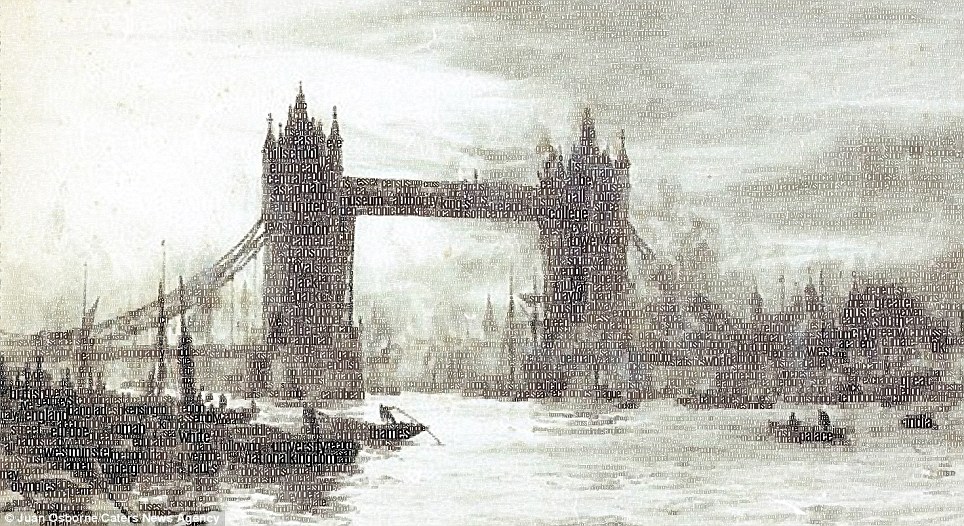
    Poetry and Art Can Be Synonymous: Artist Juan Osborne gives visual art a new figure by creating detailed portraits and landscapes made up of only words relevant to what he is creating. Although his method and medium is very different than Frost's, the emotion their work evokes is the most key component.